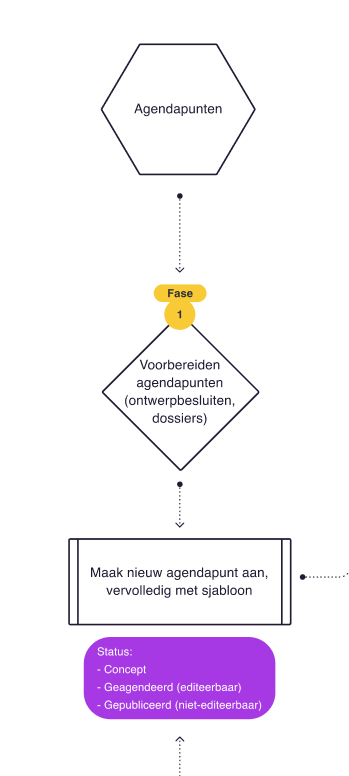
Phase 1: Prepare Agenda Items
Context
A local government prepares agenda items - also called dossiers or draft decisions - separately. This is done by the assigned department(s) within that local government. It also happens that employees of the secretariat prepare agenda items that do not require specific knowledge, such as the approval of the minutes of the previous meeting.
Governing Bodies
The agenda items are prepared for various governing bodies. In the application you log in as an employee of a Municipality, Autonomous Municipal Corporation or Province.
Municipality (Gemeente)
City Council (Gemeenteraad)
Municipal College (CBS – College Burgemeester & Schepenen)
Mayor Autonomous (Burgemeester)
Autonomous Municipal Corporation (AGB – Autonoom Gemeentebedrijf)
OCMW
Special Committee (Bijzonder comité)
Permanent Office (Vast Bureau)
Province (Provincie)
Provincial Council (Provincieraad)
Deputation (Deputatie)
Autonomous Provincial Administration (APB – Autonoom Provinciebedrijf)
Content Agenda Item
How does it work in Gelinkt Notuleren?
Our manual gives a clear view on how GN works [Dutch].
Roles
Roles It is important that each department and all secretarial staff have the role Writer here. This is set on the Gebruikersbeheer (User Management – ACM-IDM), usually by the IT service of the local government.
Readercan view all agenda items.Writercan view and edit all agenda items.
Location
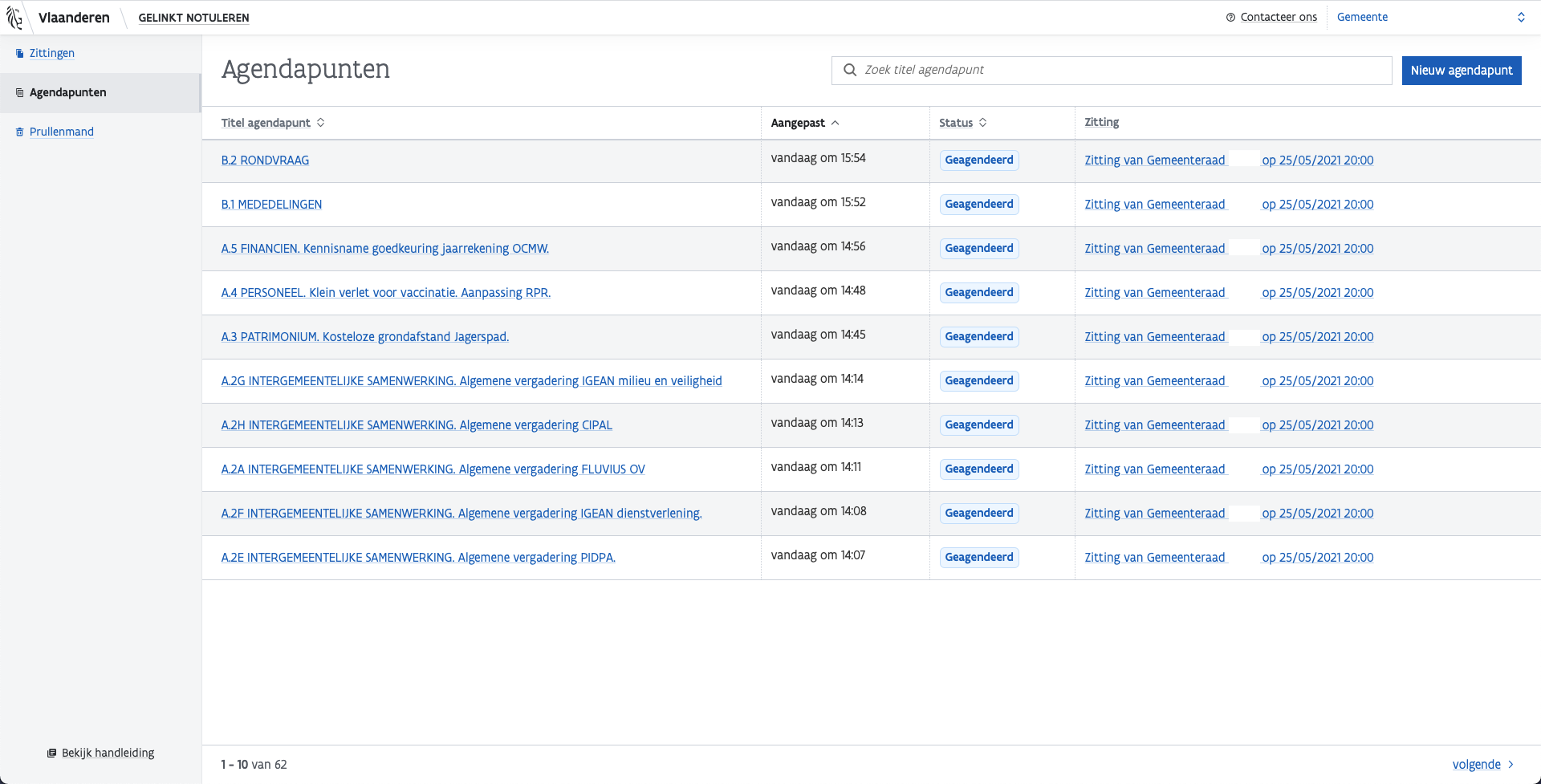
In Gelinkt Notuleren, files can be prepared in the Agendapunten (Agenda Items) tab. It is also possible to create a session directly and add agenda items there - but that is less flexible.
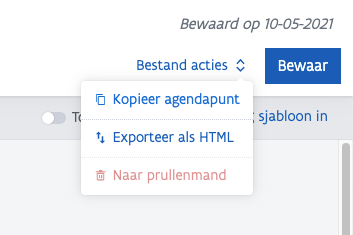
Agenda items that were adjourned can be copied so they do not have to be rebuilt.
Status
There are 3 statuses
Concept (Draft)The agenda item is in preparation, but has not yet been linked to a session. The agenda item can be modified at any time.Geagendeerd (Planned)The item has been included in a preparation for a meeting. The agenda may still change, and the agenda item may be modified.Gepubliceerd (Published)The event has been linked to a meeting and has been published. The item cannot be modified anymore.
At this stage only Concept is applicable.
Templates (Sjablonen)
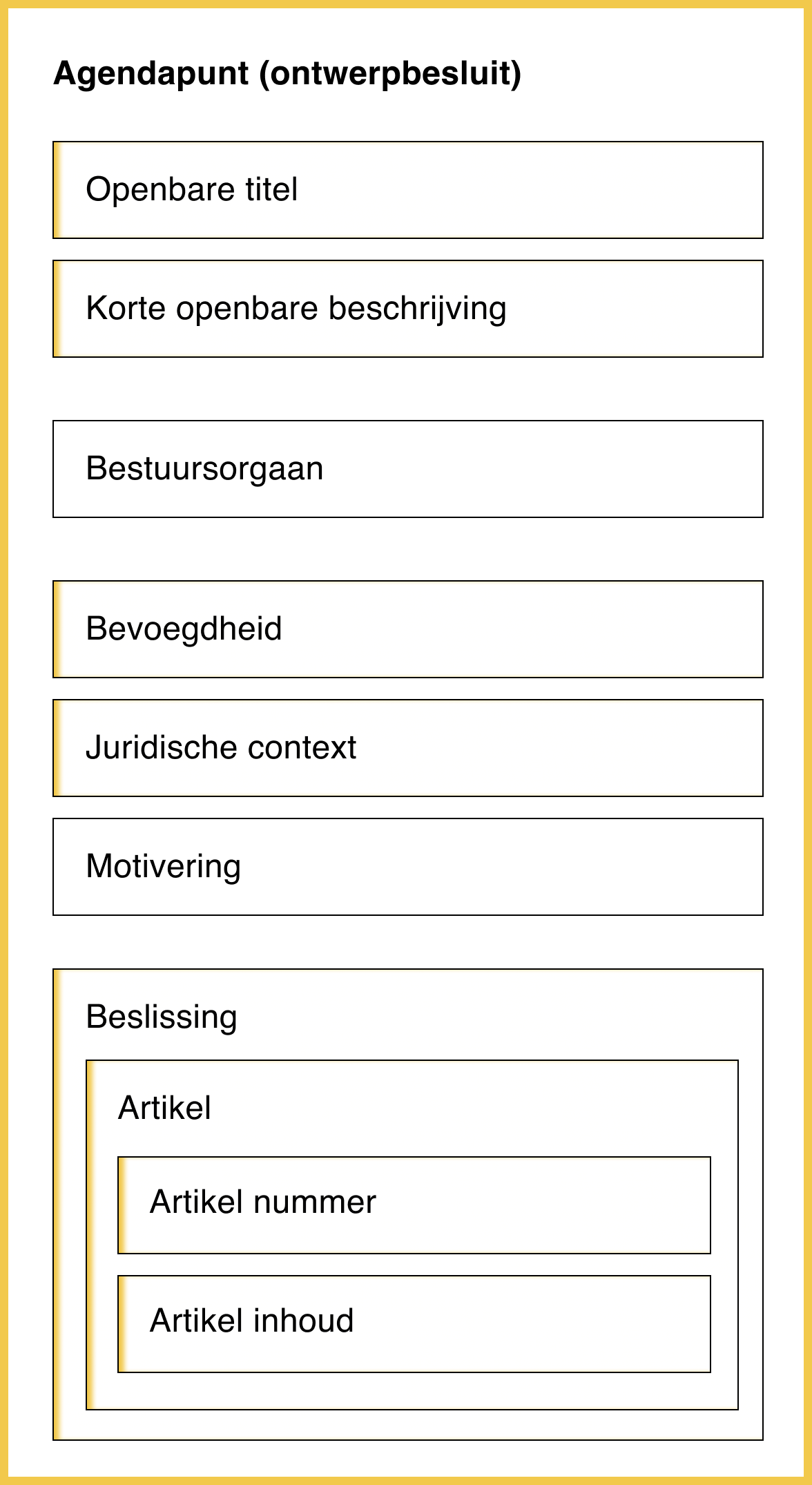
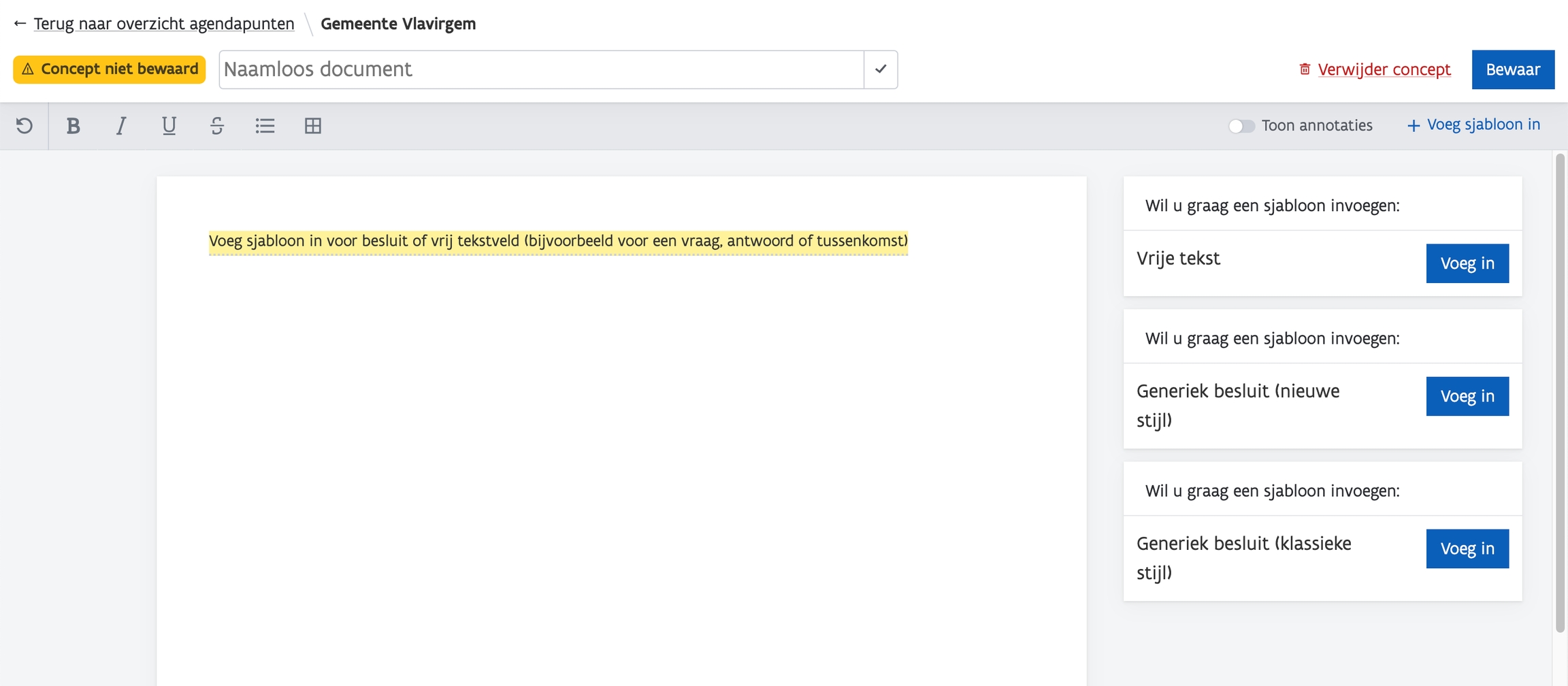
Whenever you start a new agenda item, you start with one of 2 generic templates: decisions (with an optional vote) and free text. Examples of agenda items:
Decisions
Approving of minutes of the last session
Regulations
Announcements
Free text
Discussion points
Varia
Style
We offer 2 styles for decisions:
New style: uses headings to separate authorities, legal context and rationale. Some boards use additional headings, but we make no further distinction here.
Classic style: use "gelet op (considering)" and "overwegende dat (whereas)" to separate legal context and rationale.
Last updated